
The upcoming Ujjain Airport is a greenfield aviation project under development in the historic city of Ujjain. It marks a significant step in strengthening regional air connectivity within Madhya Pradesh and is expected to reshape travel patterns across central India.
The project has received strong policy backing, with the Madhya Pradesh cabinet approving an estimated investment of ₹590 crore in April 2026. The development includes land acquisition of approximately 437.5 acres near the existing Datana–Matana airstrip in the Dadanath area of Ujjain. The project builds on earlier aviation attempts in the region and now aims to establish a scalable commercial airport capable of handling larger aircraft after phased expansion.
Unlike a city-centric airport model, this development is designed as a regional connector that enhances accessibility between pilgrimage, trade, and urban hubs.
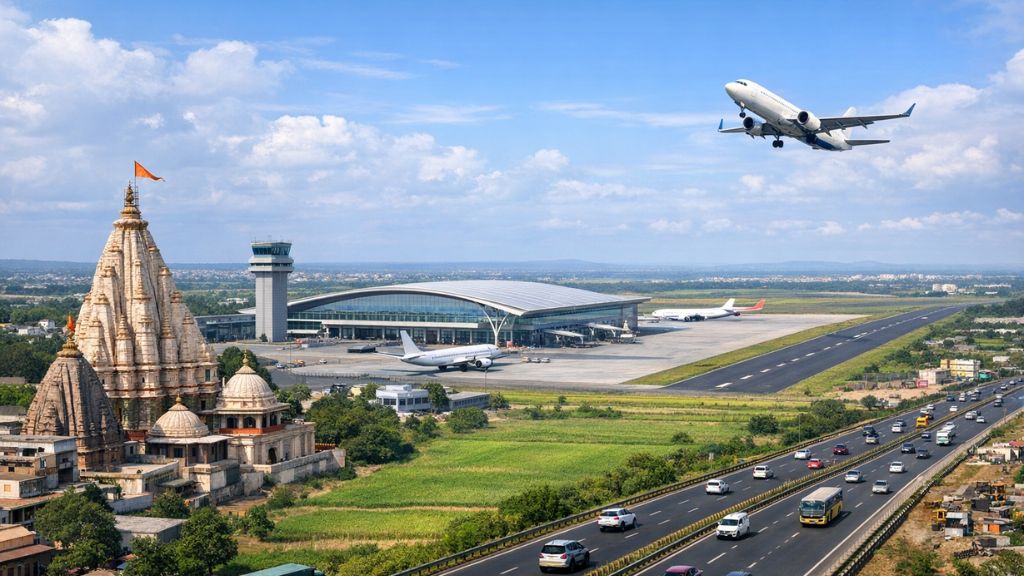
Table of Contents
Location and Strategic Importance
Although often referenced in relation to Indore due to proximity, the airport is not within Indore’s immediate urban boundary. It is located roughly 55 km away from the existing Devi Ahilyabai Holkar Airport.
This positioning is strategically important. Instead of competing directly with Indore’s established aviation hub, the new airport is intended to complement it. The Indore–Ujjain corridor is already a high-movement zone due to religious tourism, commercial exchanges, and intercity commuting. The airport adds a new layer of accessibility, particularly for pilgrims and domestic travelers who currently depend heavily on Indore for air connectivity.
From a regional planning perspective, this creates a dual-airport ecosystem that can distribute passenger load more efficiently across central Madhya Pradesh.
Timeline and Current Status in 2026
As of April 2026, the Ujjain Airport project is in the early execution phase following formal approval. Land acquisition and preliminary infrastructure planning are the immediate priorities, including runway development, terminal design, and associated connectivity infrastructure.
The central government is expected to oversee construction under the UDAN (Regional Connectivity Scheme), which focuses on improving affordable air access in underserved regions.
State leadership has indicated an ambitious timeline, with completion targeted before Simhastha 2028, a major religious congregation that significantly increases visitor inflow to Ujjain. Chief Minister announcements also suggest parallel development of other regional airports in Madhya Pradesh, reinforcing a broader aviation expansion strategy across the state.
Economic and Tourism Impact
The Ujjain airport is expected to deliver multi-sector economic benefits, particularly in tourism, employment, and regional trade.
Ujjain is one of India’s most significant spiritual destinations due to the presence of the Mahakaleshwar Jyotirlinga and its role in the Simhastha Kumbh Mela. Improved air connectivity will reduce dependency on road travel from Indore and other cities, significantly improving visitor convenience and inflow.
4 Key expected impacts include:
- Expansion of hospitality and service sectors in Ujjain
- Growth in aviation-linked employment opportunities
- Strengthening of local trade and logistics networks
- Increased domestic tourism circulation in Madhya Pradesh
By improving access, the airport is positioned as a long-term catalyst for economic diversification in the region.
Impact on Indore and Regional Connectivity
The proximity of the airport to Indore creates an interesting dynamic rather than competition. With Devi Ahilyabai Holkar Airport already operating as a major aviation hub, serving millions of passengers annually, the new airport is expected to redistribute regional demand rather than replace existing infrastructure.
This dual-airport structure can reduce congestion at Indore’s terminals while improving last-mile accessibility for travelers heading to Ujjain and nearby districts.
From a transport planning perspective, the corridor between Indore and Ujjain is likely to evolve into a high-value development axis. Improved air connectivity tends to accelerate parallel upgrades in highways, logistics parks, and commercial infrastructure, strengthening the entire regional economy.
Real Estate Growth Along Indore–Ujjain Corridor
One of the most significant secondary impacts of the Ujjain Airport project will be its influence on real estate dynamics between Indore and Ujjain.
Infrastructure-led development typically drives appreciation in land values, especially in peri-urban and corridor zones. The 55 km stretch connecting the two cities is expected to see gradual but sustained demand growth in both residential and commercial segments.
Key real estate trends likely to emerge include:
- Increased demand for plotted developments along highway-linked zones
- Growth of hospitality and budget accommodation clusters near Ujjain Airport
- Expansion of logistics and warehousing facilities due to improved connectivity
- Rising interest from investors anticipating long-term capital appreciation
This pattern aligns with infrastructure-driven appreciation cycles observed in other Indian airport corridors, where improved accessibility acts as a primary value driver.
While Indore already functions as a mature urban market, the additional connectivity is likely to extend its influence outward, creating a more integrated regional property landscape rather than isolated city-centric growth.
Read More About Indian Infrastructures:
- Upcoming Infrastructure Projects to Watch in India 2025–26
- Top 10 Infrastructure Projects Transforming Real Estate Growth in Maharashtra by 2025
- Hyderabad Property Growth 2026: What the New Road Infrastructure Means for Real Estate
Conclusion
The development of the Ujjain Airport represents a significant infrastructure milestone for Madhya Pradesh. Positioned strategically near Ujjain and within close proximity to Indore, the project is designed to strengthen regional connectivity, support tourism growth, and enhance economic integration.
With completion targeted before Simhastha 2028, the airport is expected to play a crucial role in managing large-scale pilgrim movement while also supporting long-term commercial aviation needs.
Rather than disrupting existing infrastructure such as Devi Ahilyabai Holkar Airport, it is more likely to function as a complementary asset, reinforcing Madhya Pradesh’s position as a growing aviation and investment hub.
For real estate and infrastructure stakeholders, the Indore–Ujjain corridor is emerging as a key growth belt to watch over the coming years.