
For many senior citizens in India, retirement planning follows a familiar pattern: savings, pension income, fixed deposits, and family support. Yet there is another asset often left untouched, the home they live in. In many cases, a family house may be the largest asset a retiree owns, but it does not generate income. A reverse mortgage was created to address exactly this gap.
A reverse mortgage allows eligible senior citizens to convert part of their home equity into regular cash flow without selling the property or vacating it. In principle, it offers financial dignity and independence in old age. In practice, however, it remains one of the least adopted financial products in India.
This raises an important question: Is a reverse mortgage an underused retirement solution, or does it carry risks that justify the hesitation?
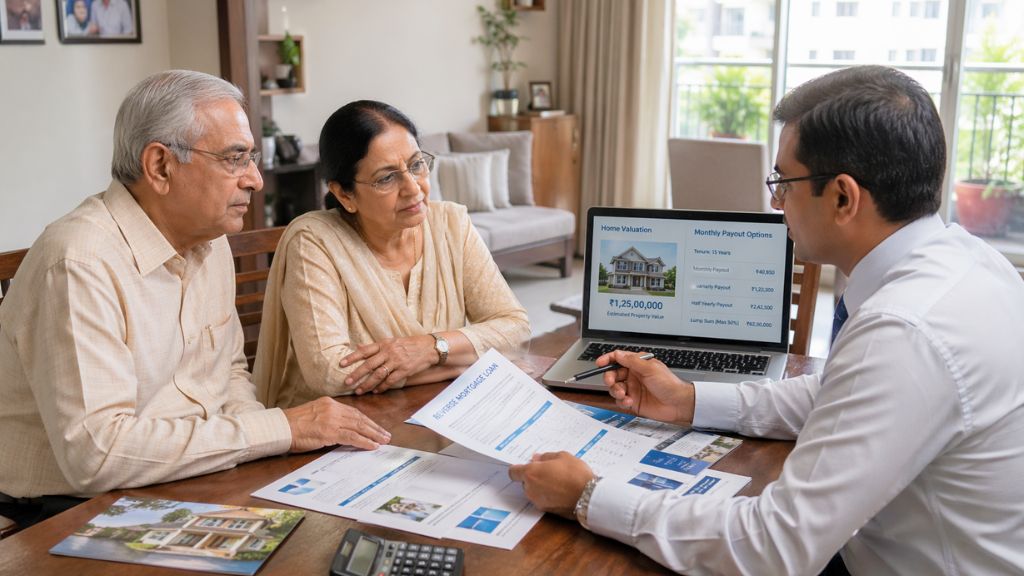
Table of Contents
What Is a Reverse Mortgage?
A reverse mortgage is a loan against a self-occupied residential property. Instead of the borrower paying EMIs to the bank, the lender pays the homeowner through monthly instalments, periodic payouts, or a limited lump sum.
The borrower continues to own and occupy the property during their lifetime, subject to the loan terms. Repayment is usually triggered after the death of the last surviving borrower or if the property is permanently vacated. At that stage, the lender recovers the outstanding dues, typically through the sale of the property, unless the heirs choose to repay the amount.
In simple terms, it converts an illiquid asset into usable retirement income.
Why It Matters in India
India has a growing elderly population, rising healthcare costs, and uneven pension coverage. Many retirees are asset-rich but income-constrained. They may own a house in a valuable urban location while depending on a modest monthly income.
For such households, a reverse mortgage can provide:
- Supplemental income during retirement
- Funding for medical treatment or assisted care
- Greater financial independence
- Reduced dependence on children or relatives
In theory, it is a rational solution. Yet adoption remains limited.
Who Can Apply?
Eligibility standards vary by lender and may change over time, but commonly include:
- Primary borrower aged 60 years or above
- Joint applications allowed, with spouse meeting minimum age criteria
- Self-owned residential property with a clear legal title
- Self-occupied home used as primary residence
- Property with sufficient remaining life, often around 20 years or more
Banks also assess marketability, location, and condition of the property.
How Payments Work
Depending on lender policy, disbursement may be structured as:
- Monthly income payouts
- Quarterly or annual payments
- Partial lump sum for specific needs
- A combination of regular income and a limited upfront payment
Loan limits are linked to property valuation, borrower age, tenure selected, and prevailing interest rates.
The Strongest Advantage: Income Without Sale
The central benefit of a reverse mortgage is straightforward: retirees can draw value from their home while continuing to live in it.
For a senior citizen with limited pension income, this can reduce financial stress significantly. It may help cover recurring healthcare costs, domestic assistance, maintenance expenses, or daily living needs.
Amounts received are generally treated as loan proceeds rather than taxable income, subject to prevailing tax law.
Why Many Families Still Avoid It
Despite its utility, the reverse mortgage faces practical and emotional resistance in India.
1. Inheritance Concerns
Residential property is often viewed not merely as an asset, but as an intergenerational legacy. Many families are reluctant to encumber a house that children may inherit.
2. Compounding Interest
Interest accrues over time, increasing the total liability. Over long tenures, the outstanding amount can grow substantially.
3. Limited Product Awareness
Many retirees are unfamiliar with the structure, eligibility rules, and long-term implications. As a result, the product is rarely considered during retirement planning.
4. Conservative Lending Structures
Some products have modest payout levels relative to property value, making them less attractive than expected.
Responsibilities of the Borrower
A reverse mortgage does not remove ownership responsibilities. Borrowers are generally expected to:
- Maintain the property
- Pay municipal taxes and utility charges
- Keep insurance active, where required
- Continue occupying the house as a primary residence
Failure to meet these conditions may affect the loan arrangement.
Is It the Right Choice?
A reverse mortgage may be suitable when:
- Retirement income is insufficient
- Significant wealth is locked in a home
- There is no desire or need to sell immediately
- Liquidity is required for healthcare or living expenses
- Heirs are informed and supportive of the decision
It may be less suitable when family succession planning is the priority or where alternative income sources already exist.
Reverse Mortgage in India: Is It a Good Retirement Option?
Reverse mortgage in India deserves more serious attention than it currently receives. For many senior citizens, it can be a practical retirement planning solution when regular income is limited but substantial wealth is tied up in residential property.
A reverse mortgage loan for senior citizens is not a distress product, nor does it automatically mean losing ownership during one’s lifetime. It is a structured financial tool that allows homeowners to unlock home equity and receive regular income while continuing to live in their house.
For retirees facing rising healthcare costs, inflation, or inadequate pension income, a reverse mortgage for senior citizens may help create financial stability without selling the property immediately.
That said, reverse mortgage schemes in India should be evaluated carefully. Loan tenure, payout amount, property valuation, interest accumulation, eligibility conditions, and repayment terms differ from one lender to another. Understanding these terms is essential before applying.
There is also a cultural factor. Many Indian families prefer to preserve real estate for inheritance, even when elderly parents need better retirement income today. This often prevents practical financial decisions.
So, is a reverse mortgage a good option in India? For some homeowners, yes, especially those who are property-rich but cash-flow poor. For others, alternatives such as downsizing, rental income, or family planning may be more suitable.
The right decision depends on retirement goals, family expectations, property value, and long-term financial needs.
Conclusion:
A house can provide shelter, status, and security. In retirement, it can also provide income. A reverse mortgage gives senior citizens the option to use an existing asset instead of depending entirely on savings or family support.
It is neither universally good nor inherently risky. It is a tool, and like any financial tool, its value depends on when, why, and how it is used.