
India’s real estate market has been going through a visible shift since 2024. What was once driven mainly by housing demand is now being shaped by steady Industrial Land Acquisition from industrial, pharmaceutical, logistics, and manufacturing sectors. This change continued through 2025 and is expected to influence market direction in 2026 as well, according to insights shared by major real estate research bodies and market observers.
The scale of land transactions over the last two years shows how industrial land acquisition has become an important part of Indian real estate growth.
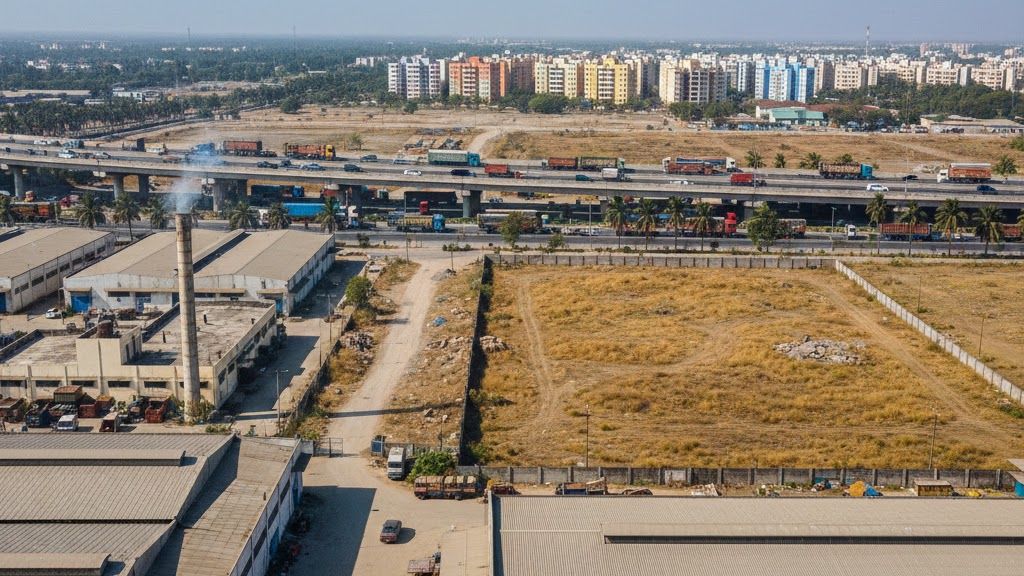
Table of Contents
Rising Industrial Land Acquisition in India
Industrial land acquisition picked up strongly in 2024, with around 2,335 acres transacted during the year. This momentum increased further in the first half of 2025, when nearly 2,898 acres were transacted across 76 deals. These transactions were spread across manufacturing zones, logistics hubs, and upcoming industrial clusters.
This rise reflects long-term planning by companies looking for stable locations with road access, utilities, and room for future expansion. Unlike short-term property use, these land purchases are linked to ongoing operations, which adds consistency to real estate activity.
Impact on the Indian Real Estate Market Structure
The growing focus on industrial land has gradually changed the structure of the Indian real estate market. Residential projects remain important, but they are no longer the only driver. Industrial, logistics, and commercial spaces are now contributing a larger share to overall activity.
As industrial projects come up, surrounding areas often see demand for worker housing, rental homes, small offices, and daily-use retail. This creates connected growth rather than isolated development, especially in areas outside city centers.
Expansion into Tier II and Tier III Cities
One of the most notable trends in industrial land acquisition is the expansion into Tier II and Tier III cities. During 2024, these cities accounted for about 28% of total land transactions. Locations such as Nagpur, Indore, Varanasi, and Ludhiana have drawn interest due to better land availability and improving connectivity.
Compared to large metro cities, these locations offer lower entry costs and fewer space limits. As a result, suburban land prices around these cities have shown steady upward movement. Improved highways, freight routes, and local infrastructure have made these regions more practical for large-scale projects.
Investment Flow Supporting Land and Property Demand
Investment activity has followed this pattern. In the first half of 2025, private equity inflows into Indian real estate increased by about 38% year-on-year, reaching close to INR 20,566 crore. A significant share of this investment has gone into industrial and commercial land-based projects.
This flow of funds highlights growing interest in income-linked real estate segments such as warehouses, industrial parks, and office spaces. These assets are often backed by long-term users, which adds stability to the market.
Effect on Land Prices and Peripheral Areas
Higher demand for industrial land has influenced land prices, particularly in city outskirts and along major transport routes. Areas near highways, logistics corridors, and industrial belts have seen stronger interest compared to inner city zones.
Urban peripheral regions that were once considered distant are now viewed as practical locations due to better road access and planned infrastructure. This shift has changed how landowners and developers view future land use, especially in growing cities.
Infrastructure and Industrial Corridor Development
Infrastructure growth has supported this real estate shift. Ongoing development of industrial corridors, freight routes, and utility networks has opened up new areas for land-based projects. These improvements have made it easier for industries to operate outside crowded urban centers.
As infrastructure reaches new regions, real estate activity follows. Land that earlier had limited commercial use is now being considered for industrial or mixed-use development, widening the real estate market base.
Strategic Location Focus in Land Deals
Another important aspect of recent land transactions is the focus on strategic locations. Buyers are giving priority to access, transport time, and nearby support services rather than just proximity to large cities.
This approach reflects a more planned and data-driven market where land is selected based on long-term usability. Such trends have reduced random expansion and encouraged more balanced regional development.
Indian Real Estate Forecast for 2026
Looking ahead to 2026, real estate think tanks and market studies suggest that industrial land acquisition is likely to remain steady. While the pace may moderate compared to the sharp rise seen in early 2025, demand for land linked to manufacturing, logistics, and storage is expected to continue.
Tier II and Tier III cities are likely to attract a growing share of future land deals as companies look for cost balance and operational ease. Investment inflows are also expected to remain supportive, especially for projects aligned with infrastructure growth and long-term use.
Residential real estate is expected to benefit indirectly, as industrial expansion supports job creation and local population growth. This linked development may shape new housing clusters around industrial zones rather than within crowded city cores.
What This Means for Buyers and Sellers
For landowners, especially in emerging regions, the last two years have expanded buyer options beyond traditional housing developers. Industrial and commercial users are now active participants in the land market.
For buyers and investors, understanding future infrastructure plans and nearby industrial activity has become increasingly important. Locations connected to upcoming transport routes or employment hubs may see gradual demand growth over time.
Conclusion
Industrial land acquisition during 2024 and 2025 has played a key role in reshaping the Indian real estate market. With over 5,200 acres transacted across this period and investment inflows crossing INR 20,000 crore in early 2025, the influence of industrial and commercial demand is clear.
As the market moves into 2026, this trend is expected to support balanced growth across residential, industrial, and commercial segments. The continued rise of Tier II and Tier III cities, backed by infrastructure development, is likely to remain an important part of India’s real estate story.