
Introduction
When evaluating buying property, most buyers begin with the advertised base price. This figure often appears straightforward and comparable across projects. However, the base price typically represents only one part of the overall financial commitment. Several additional charges, some standard and some project-specific, are added during different stages of the transaction.
These costs are not necessarily hidden in a legal sense, but they may not always be clearly highlighted in initial discussions or marketing material. As a result, the final amount payable can differ noticeably from the quoted price. Understanding these components helps buyers assess affordability more accurately and review project cost sheets with greater clarity.
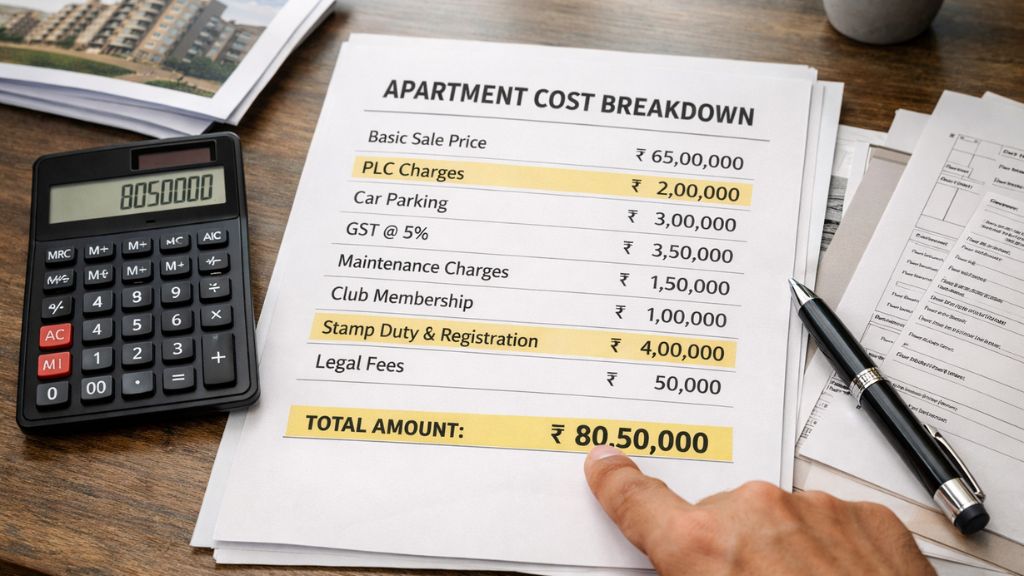
Table of Contents
Understanding the Difference Between Base Price and Total Cost
To interpret property pricing correctly, it is essential to distinguish between the base price and the overall payable amount. This distinction forms the foundation for evaluating any real estate transaction.
The base price generally refers to the cost calculated per square foot of the apartment, based on the agreed area metric. This is the figure most commonly used in advertisements and early-stage communication.
The total cost, however, includes several additional components such as statutory charges, development-related fees, and service-related costs. These may be listed separately in a detailed cost sheet provided by the developer.
A clear understanding of this difference allows buyers to move beyond headline pricing and evaluate the complete financial scope of a property.
Common Charges Added to the Base Property Price
Once the base price is established, the next step is to examine the additional components that are commonly included in residential projects. These charges are typically outlined in the cost sheet and vary depending on the project configuration.
Preferential Location Charges (PLC)
Preferential Location Charges are applied to units that are positioned in a way considered advantageous within a project. This may include factors such as proximity to landscaped areas, better views, or corner placements. The applicability and amount vary across developments and are usually specified in the cost sheet.
Floor Rise Charges
In multi-storey residential buildings, developers may apply incremental charges based on the floor level of the unit. These charges are typically calculated per floor above a certain level and are more commonly observed in high-rise projects.
Clubhouse and Amenity Charges
Residential projects that include shared facilities such as clubhouses, fitness centres, or recreational spaces may include a one-time fee for access. These charges are separate from the base price and may also be accompanied by ongoing maintenance contributions.
Parking Charges
Parking spaces are often treated as a separate component in the pricing structure. The cost may differ depending on whether the parking is open, covered, or within a designated structure. Allocation policies and pricing are usually defined in the agreement.
Maintenance Charges (Advance Collection)
Developers may collect maintenance charges in advance for a defined period, commonly covering the initial phase after possession. These funds are intended for the upkeep of common areas, security services, and basic operational needs of the residential complex.
Corpus Fund or Sinking Fund
A corpus fund is generally collected as a reserve for long-term repairs and structural maintenance. This is typically a one-time contribution made at or before possession and is managed by the society or association formed later.
Statutory and Government-Related Charges
Beyond project-level pricing, there are statutory components that are part of the legal process of property ownership. These charges are regulated and form a necessary part of the transaction.
Goods and Services Tax (GST)
GST is applicable to under-construction properties, subject to prevailing regulations. The rate and applicability may depend on factors such as project type and classification.
Stamp Duty and Registration Charges
Stamp duty and registration fees are mandatory charges associated with the legal transfer of property ownership. These are governed by state regulations and vary accordingly.
Together, these statutory components contribute significantly to the overall cost and are typically payable at specific stages of the transaction.
Additional Charges That May Appear in Cost Sheets
In addition to the commonly known and statutory charges, cost sheets may include several other components. These are often project-specific and can vary in structure and amount.
- Infrastructure Development Charges (IDC/EDC): Infrastructure Development Charges and External Development Charges are linked to the development of supporting infrastructure such as roads, drainage systems, and utilities.
- Power Backup Charges: In projects that provide backup power systems, a separate fee may be included for installation or usage.
- Water and Electricity Connection Charges: Initial connection fees for utilities such as water and electricity are often collected as one-time charges.
- Mutation and Administrative Charges: Mutation refers to the process of updating ownership records with local authorities. Administrative or processing fees related to documentation may also be included.
- Society Formation Charges: Developers may collect charges associated with the formation of a cooperative housing society or resident welfare association as part of the transition after possession.
Illustrative Cost Structure for Better Clarity
To understand how these components come together, it is useful to look at a simplified structure. While exact numbers vary by project, the pattern of additions remains broadly similar.
For example, a base price may be supplemented by:
- Project-related charges such as PLC, amenities, and parking
- Statutory costs including GST, stamp duty, and registration
- Administrative and utility-related charges
This layered structure explains why the final payable amount differs from the initial quoted figure. Reviewing such breakdowns on platforms like Openplot.com can help in comparing multiple projects with clearer cost visibility.
Reading and Interpreting a Property Cost Sheet
A cost sheet serves as the primary document for understanding how pricing is structured. Reading it carefully provides clarity on both the components and the sequence of payments.
Typically, a cost sheet includes:
- Base price and unit area details
- List of additional charges with descriptions
- Tax components and statutory fees
- Payment schedule linked to construction stages
Projects registered under Real Estate (Regulation and Development) Act, 2016 are required to disclose specific project and pricing details, which can support a more structured review.
Factors That Influence Variation in Charges
Not all projects follow the same pricing structure. Variations arise due to multiple factors that influence how costs are distributed and presented.
These factors include location, type of development, scale of amenities, and local regulatory requirements. Urban projects with extensive facilities may include more line items, while smaller developments may have relatively simpler cost structures.
Understanding these variations helps in making more accurate comparisons across different property options.
Impact on Overall Financial Planning
Once all components are considered, the total financial requirement extends beyond the base price. This has a direct influence on how buyers plan their finances over the purchase timeline.
Some charges are payable upfront, while others are linked to construction milestones or possession. This staggered structure requires careful planning to ensure liquidity at different stages.
Access to structured listings and clearer cost breakdowns on platforms such as Openplot can support this planning process by offering better visibility into project-level pricing.
Points to Review Before Finalising a Property Purchase
Before proceeding with a transaction, it is useful to review the complete list of charges and ensure that each component is clearly defined in the documentation.
A basic review can include:
- Verification of all cost components in the cost sheet
- Alignment between quoted price and agreement terms
- Clarity on one-time versus recurring charges
This approach supports a more consistent understanding of the overall investment.
Conclusion
Property pricing in India involves multiple components beyond the advertised base rate. These include project-specific charges, statutory fees, and service-related costs that together determine the total financial outlay.
A structured review of these elements enables buyers to interpret pricing more accurately and compare properties on a like-for-like basis. Platforms such as Openplot contribute to this process by presenting organised property information and helping users navigate project details with greater clarity.
Frequently Asked Questions
What are hidden charges in real estate transactions?
They refer to additional costs beyond the base price, such as amenity fees, statutory charges, and administrative expenses listed in the cost sheet.
Are all charges mentioned in the agreement?
Most charges are included in formal documentation, though their visibility may vary in early-stage communication.
Do all projects have the same types of charges?
No, the structure and number of charges can differ depending on the project, location, and developer practices.
Is GST applicable to all property purchases?
GST is generally applicable to under-construction properties, subject to current regulations.
Why is it important to review the cost sheet carefully?
It provides a complete breakdown of the total cost and helps in understanding all financial components before finalising the purchase.