
The 15-minute city is attracting global interest, and India is gradually catching up with it. The concept is straightforward: individuals are expected to walk or ride a bike to work, schools, markets, healthcare facilities, and parks within 15-minute cities. This will reduce travel time, conserve fuel, and promote healthier, more interdependent communities. As the urban population in India is expected to rise to almost 600 million people by the year 2030, the model will determine the location of choice of people as well as have a direct impact on housing demand.
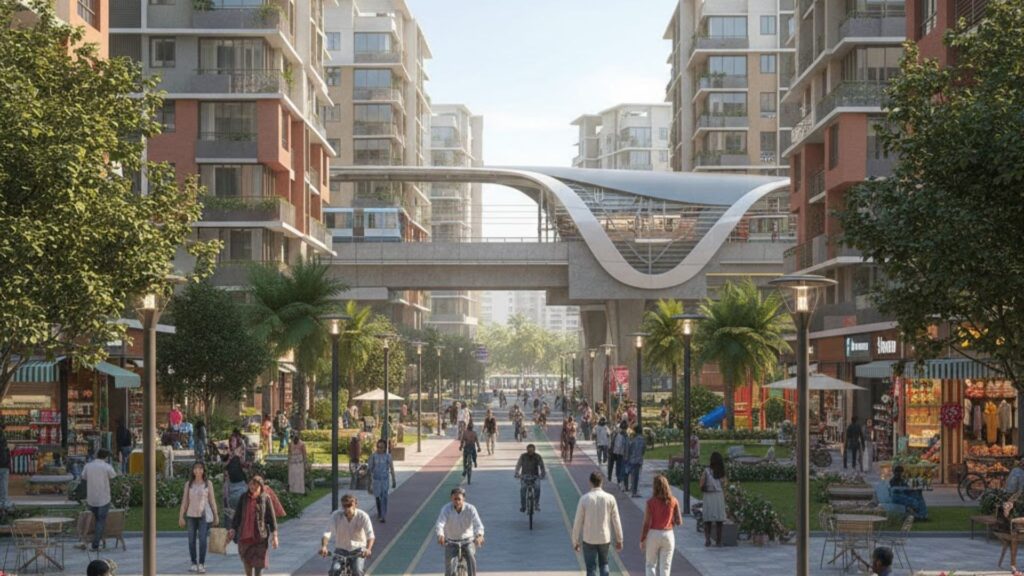
Table of Contents
Movement to Walkable and Self-Sufficient Neighborhoods.
Nowadays, a large number of buyers of houses prefer to purchase in the districts that are distant to the cities due to their pricing or a lack of alternatives. They like living in areas where all types of facilities are within reach in a 15-minute city. The desire will be to move out of far-off suburbia to densely populated city zones. These districts are residential, commercial and business oriented areas. The outcome is reduced travelling and healthier lifestyle.
Buyers will not prefer enormous, far in between housing colonies, but rather smaller, well-planned clusters which would enable them to complete the daily chores without having to drive. The buyers will be interested in walkability, safe foot paths, bike lanes and convenient access to local areas.
Increasing Significance of Cheap and Non-Discriminatory Housing.
With the 15-minute model implementation in cities, the housing demands will change. The demand will be more in the city centers particularly to the professionals and families one wishes to be close to jobs, schools and services. The governments and constructors should pay more attention to affordable housing, which is not only in the outer parts of the city.
The redevelopment of slums and the older regions will be important. Low- and middle-income residents will be housed in clean and safe residential quarters which are well-linked to promote social stability. It will enable people with different incomes to co-exist in the neighborhood and share amenities.
The Emergence of Transit-Oriented and High-Density Housing.
In the major Indian cities, the metro and bus networks are being developed, which suits the 15-minute model perfectly. Houses adjacent to stations, bus terminals, and the end-mile locations will be in more demand. These places are already fast to work and get services and a 15-minute plan will be even more appealing.
There will be a tendency to live in such compact, high-density houses as small units. These houses are good to individuals who want to travel less and have easy access within the region. People might opt to use apartments that might encourage the use of walking and moving about other than big, far-between single-family houses.
Eco-friendly and Community-oriented lifestyle.
The increased environmental consciousness will result in the new housing development that will be characterized by increased green spaces, energy-efficient constructions, and community spaces. The central planning focus will not be on the use of parks, open spaces, play areas, and shared activity spaces as an add-on. The aspects enhance everyday life, and they help to maintain active and healthy communities.
The use of rainwater harvesting, solar panels, waste systems and cleaner methods of construction can also gain popularity, with cities constructing comfortable, long-term sustainable communities.
Live: Residential Supporting Local Workforce and Small Business.
The Indian urban economy is heterogeneous. A number of them operate small shops, work at home, or consider part-time or informal jobs. This is supported by the 15-minute model which promotes mixed-use buildings in which people can live and work side by side. Smaller stores, small offices, co-working areas, home home-based businesses will define the demand of flexible housing designs.
Buyers can be interested in houses that are practical in terms of spending and working. Commercial units of the first floor, corners of small businesses and shared work areas in the projects may gain popularity.
The Smartest Planning with Technology.
Data and technology will play a bigger role in planning in the growing cities. GIS, AI analysis and digital mapping assist planners to know the patterns of movements, the services missing and development requirements. This will enhance better road and transport and utility planning, which will make 15-minute neighborhoods more feasible.
The last-mile transportation, such as shuttle services, cycle-sharing centers, e-rickshaw points, and pedestrian crossing, will help to make living more comfortable and make people tend to locate their homes in such regions.
Indian 15-Minute Cities That Are Already Moving to the Model.
| City | Type of Development Seen |
| Bengaluru | Walkable layouts, mixed-use zones, metro growth |
| Mumbai | Redevelopment projects, transit-focused housing |
| Chennai | Neighborhood-level planning, better local access |
| Pune | Metro expansion, active mobility plans |
| Ahmedabad | Transit-oriented development and improved roads |
Conclusion
The 15-minute city model may influence the development of Indian cities and the residential preferences of people by 2030. Homebuyers will be interested in neighborhoods that provide ease, cohesiveness, and convenience due to less travel time, better access to many of their daily needs, and enhanced public spaces. The demand will be inclined towards mixed-use areas, walkable ones with excellent transportation, and considerate planning. In the case of a property platform such as Openplot, this move presents a strong chance to emphasise on the properties that suit these new urban requirements. With the development of the cities, buyers will use more platforms that assist them in locating homes in well-connected, future-oriented neighborhoods, and Openplot will be necessary in their search.