
India’s urban housing demand is being reshaped by the steady expansion of the IT and ITeS sectors. Large office clusters across cities are attracting a young, mobile workforce that prioritizes flexibility over long-term ownership.
This shift has accelerated the demand for rental housing, especially shared formats such as PGs and co-living spaces. What was once considered a temporary solution is now becoming a structured and essential segment of urban real estate.
As IT hubs continue to expand, their influence on where and how people live becomes more visible in surrounding residential markets.
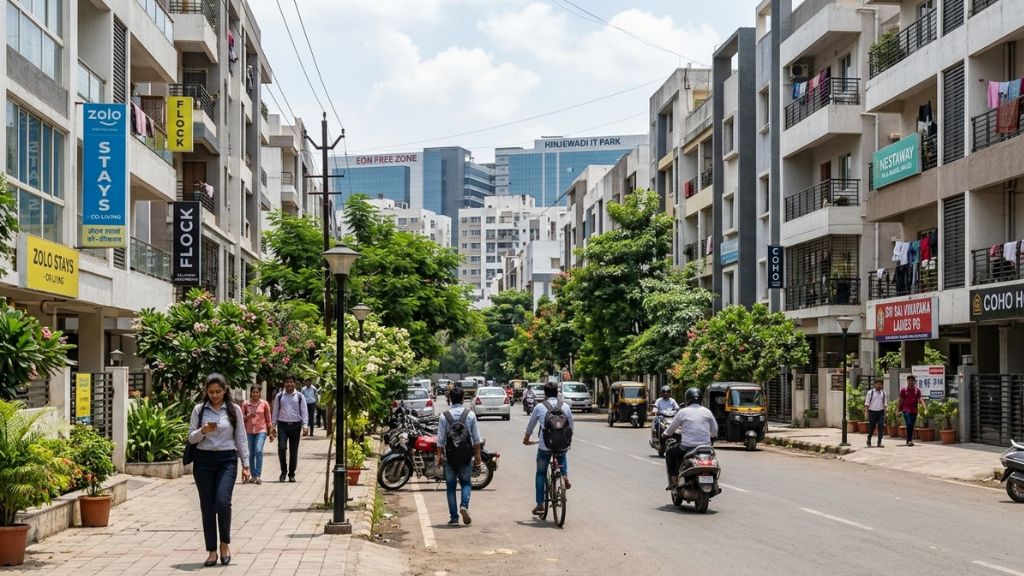
Table of Contents
IT Corridors as Catalysts for Rental Demand
How IT hubs influence housing patterns
IT corridors act as anchors for residential demand. As companies expand office space, nearby localities experience parallel growth in rental absorption.
Key micro-markets highlight this trend:
- Whitefield and Outer Ring Road in Bengaluru
- HITEC City–Gachibowli in Hyderabad
- Hinjewadi–Kharadi in Pune
- OMR corridor in Chennai
These areas consistently show strong occupancy levels due to their proximity to workplaces.
Why location matters for tenants
For most working professionals, housing decisions are driven by practical factors:
- Shorter commute times reduce daily travel stress
- Access to the metro and public transport improves connectivity
- Proximity to offices increases long-term convenience
- Availability of social infrastructure supports daily living
This concentration of demand makes IT corridors some of the most stable rental markets in India.
This strong location-driven demand has also influenced the type of housing formats that develop in these areas.
Evolution of Shared Housing: From PGs to Co-Living Models
The PG model has historically served students and early-career professionals by offering affordable accommodation. However, it has often been unstructured, with inconsistent service quality and limited transparency.
Co-living has emerged as a more organized alternative. It introduces standardized services, formal agreements, and managed operations. Unlike traditional PGs, co-living spaces are designed to provide a complete living environment rather than just a place to stay.
This evolution reflects a broader shift toward professionalisation in rental housing, where tenants expect reliability, clarity, and better living conditions.
As the format evolves, the expectations of tenants are also changing in parallel.
Changing Tenant Expectations and Lifestyle Preferences
What today’s tenants look for
The current workforce, largely composed of Gen Z and millennials, has redefined rental housing expectations. Their priorities extend beyond affordability to include convenience and overall experience.
- Flexible lease terms with minimal lock-in
- Fully furnished, ready-to-move-in spaces
- All-inclusive pricing covering utilities and services
- Clean, safe, and well-maintained environments
- Access to shared spaces that support interaction
These expectations are influencing how rental housing is designed and managed across cities.
Shift from basic accommodation to experience
Housing is increasingly viewed as part of a broader lifestyle. Tenants now evaluate properties based on comfort, design, and the ability to support their daily routines. This shift is one of the key drivers behind the growth of co-living formats.
These changing preferences are not only shaping design but also impacting the financial and operational dynamics of rental housing.
Economics and Operational Shift in Rental Housing
How IT growth impacts rental economics
The expansion of IT corridors has a direct impact on rental values and occupancy. As demand increases, well-located properties tend to maintain higher occupancy and steady rental growth.
Shared housing formats also improve space utilization. By accommodating multiple tenants, they can generate higher income per unit compared to traditional leasing.
Operational changes in managed housing
Unlike standard rentals, shared housing requires active management. This includes tenant onboarding, maintenance, and service delivery. Technology is helping streamline these processes through digital platforms, enabling better efficiency and transparency.
For property owners, this represents both an opportunity and a responsibility. Higher returns are possible, but they depend on consistent operations and tenant satisfaction.
With these models gaining traction in metros, similar patterns are now emerging in smaller cities.
Expansion Beyond Metros and Future Outlook
Emerging rental demand in Tier-2 cities
The influence of IT is no longer limited to major metros. Cities such as Jaipur, Indore, and Coimbatore are seeing increasing demand for organized rental housing.
This is driven by:
- Growth of IT companies and GCCs
- Rising student and professional migration
- Lower cost of living compared to metros
Future direction of rental housing
The rental housing market in India is gradually becoming more structured. Informal PG setups are giving way to managed formats with better compliance and service standards.
Looking ahead, the integration of living and working environments is expected to deepen. While hybrid work may influence location choices, proximity to employment hubs will continue to play a central role.
Conclusion
IT corridors have become a defining factor in India’s rental housing landscape. They influence not only where people live but also how housing is designed and managed.
The transition from traditional PGs to organized co-living reflects changing tenant expectations and the need for more structured housing solutions. As this segment continues to evolve, it presents opportunities for both tenants and property owners.
Platforms like Openplot can support this shift by improving access to verified rental options across key micro-markets, helping users navigate an increasingly organized housing ecosystem.
Frequently Asked Questions
What is the difference between PG accommodation and co-living?
PGs generally provide a room with basic facilities and minimal services, while co-living offers fully furnished rooms, utilities, housekeeping, and shared amenities. Co-living focuses on community, networking, and lifestyle, whereas PGs are primarily about affordable lodging. Lease terms in co-living are also more flexible compared to traditional PGs.
Why are IT corridors driving higher rental demand in India?
IT corridors attract a large number of young professionals who prefer to live close to their workplaces. Areas near office clusters, metro stations, and social infrastructure reduce commute stress and improve quality of life. These micro-markets often show faster occupancy rates and higher rental growth compared to other city areas.
How do co-living models benefit property owners compared to traditional rentals?
Shared housing allows property owners to generate higher income per unit because multiple tenants share a single property. Managed operations and technology integration help maintain high occupancy, reduce tenant turnover, and simplify maintenance. All-inclusive pricing and consistent service standards make properties more attractive to working professionals.
Are Tier-2 cities suitable for co-living and PG investments?
Emerging IT and education hubs such as Jaipur, Indore, and Coimbatore are witnessing rising demand for organized rental housing. Lower property costs and growing employment opportunities make these cities attractive for investors. Professionalized co-living setups are gradually replacing unorganized PGs, offering a more structured and reliable housing solution.
How is technology shaping co-living and PG housing?
Technology enables seamless tenant onboarding, rent collection, maintenance requests, and access control. Smart home solutions like keyless entry and energy-efficient systems reduce operational costs. Digital management platforms allow operators to scale efficiently while improving tenant experience and satisfaction.